How can you keep real estate brokerage fees low in Japan? The legal maximums for rentals and sales, and how to choose an agency
The quickest way to keep brokerage fees low on a rental or a purchase in Japan is to choose an agency that publishes its fee structure before you start searching. A licensed broker explains, in Q&A form, how the legal maximums work, how much you save on a ¥150,000-a-month rental and a ¥70 million purchase, and what to check when choosing a low-fee agency.
How can you keep brokerage fees low?
In short: before you start looking at properties, choose an agency that publishes its fee structure. If the rate is fixed from the outset, such as “half a month’s rent (0.5 months plus tax)” for rentals or “half the legal maximum” for sales, there is nothing to negotiate property by property.
Rents and prices in the greater Tokyo area are on the high side, so a difference in the fee rate turns directly into a difference of tens of thousands of yen on a rental and more than a million yen on a purchase. This article walks through how the legal maximums work, what the difference looks like in concrete numbers, and what to watch for when choosing a low-fee agency.
What is the maximum brokerage fee?
For rentals, one month’s rent plus consumption tax. For sales over ¥4 million, 3% of the sale price plus ¥60,000, plus consumption tax. These maximums come from Japan’s Real Estate Brokerage Act (宅地建物取引業法), so no agency can charge more than this.
- Rentals: the combined fee an agency may receive from the landlord and the tenant is capped at one month’s rent plus tax. The tenant’s share is, in principle, half a month’s rent plus tax, and the agency may receive up to one month’s rent plus tax from the tenant if the tenant consents. (There are points to confirm about how that consent is obtained, so please check before signing.)
- Sales: when the sale price exceeds ¥4 million, the quick formula for the maximum is “3% of the sale price + ¥60,000 + tax”.
- Special rule for low-priced properties: since July 2024, for properties priced at ¥8 million or less, the maximum can be raised to ¥300,000 plus tax. (The conditions for applying this rule need to be confirmed.)
The important point is that these figures are maximums, not set prices. There is no legal minimum, so each agency is free to set its own rate.
How big is the difference? An example from Musashikosugi
About ¥82,500 on a rental at ¥150,000 a month, and about ¥1.19 million on a ¥70 million purchase. Here we compare the maximum fee with a half-price fee, using price levels typical of Musashikosugi in Kawasaki, our home area. The figures are examples only and include 10% consumption tax.
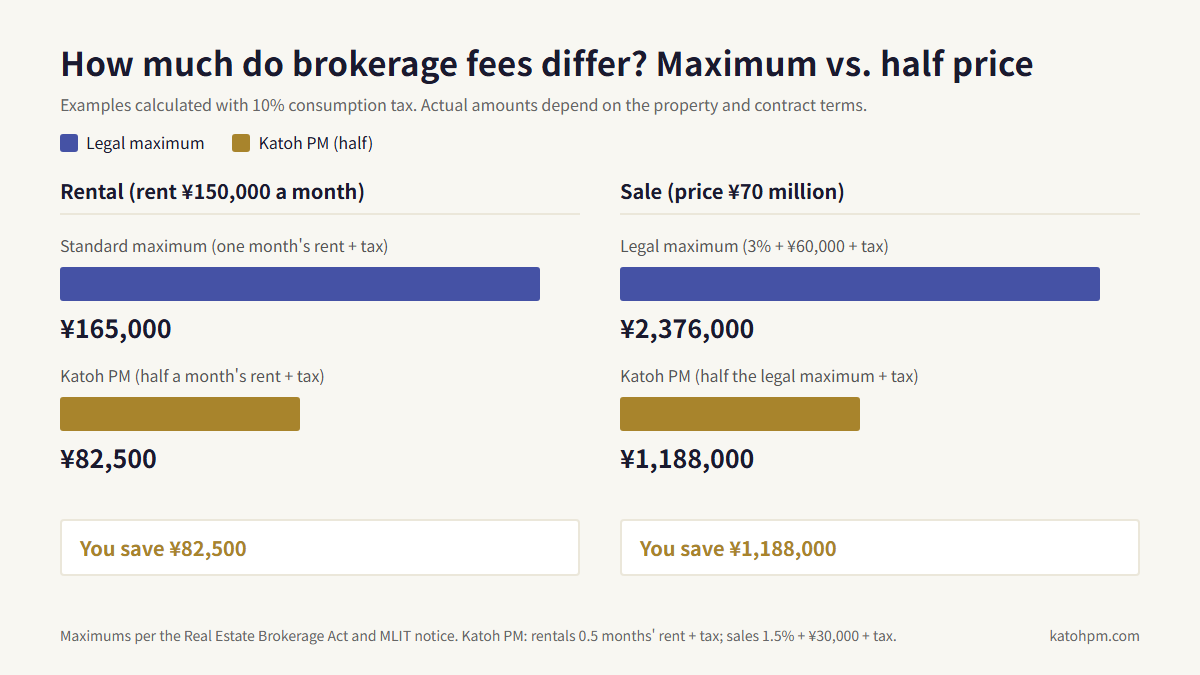
Rental example: ¥150,000 a month
| Fee structure | Calculation | Paid by the tenant |
|---|---|---|
| Maximum (one month + tax) | ¥150,000 × 1.1 | ¥165,000 |
| Half (0.5 months + tax) | ¥75,000 × 1.1 | ¥82,500 |
| Difference | ¥82,500 |
Sale example: ¥70 million
| Fee structure | Calculation | Fee |
|---|---|---|
| Maximum (3% + ¥60,000 + tax) | (¥2,100,000 + ¥60,000) × 1.1 | ¥2,376,000 |
| Half (1.5% + ¥30,000 + tax) | (¥1,050,000 + ¥30,000) × 1.1 | ¥1,188,000 |
| Difference | ¥1,188,000 |
On a purchase, the difference exceeds ¥1 million. The higher the price, as with the tower condominiums of Musashikosugi, the more the difference in rate matters. The same holds in Tokyo, Yokohama and elsewhere in the greater Tokyo area.
What should you watch for when choosing a low-fee agency?
Check three things: which properties they can handle, what services they provide, and what costs they charge besides the brokerage fee. A low fee means something different depending on whether the agency has cut steps that can be cut, or is recovering the money under another name.
- Which properties they can handle: for both rentals and sales, most properties are shared among agencies through a common listing network (REINS), so in principle you can apply through any brokerage. Some properties are handled exclusively by one agency, however. The most reliable approach is to find a property you like first, then ask, “Can you handle this one?”
- What services they provide: how far the agency goes with accompanying viewings, negotiating terms, explaining the contract documents and arranging the handover differs from agency to agency. Whether you can consult and complete the paperwork without visiting an office is also worth checking.
- Costs besides the brokerage fee: rentals sometimes add an administration fee, a document preparation fee or a disinfection fee, and sales sometimes add a loan arrangement fee. Compare the total on the written estimate, not just the fee rate.
What are the practical steps to keep fees low?
Choose the agency first, then search for properties, then compare the total estimate.
- Find an agency with a clear fee structure: shortlist agencies that state their rate on their website.
- Search through that agency, or bring them a property you have found: they can check whether they can handle a property you found on a portal site.
- Compare the total on the estimate: check for charges under other names on top of the brokerage fee.
- Reconfirm at the explanation of important matters before signing: the fee amount and when it is paid are also written into the contract documents.
What about Katoh Property Management?
Rentals are half a month’s rent (0.5 months plus tax). Sales are half the legal maximum (1.5% of the sale price plus ¥30,000, plus tax). A fee is charged only when a contract is concluded; nothing is charged for consultations or estimates.
These rates apply to new inquiries received through the form on this website, LINE or a personal referral. Inquiries about properties we list on portal sites or elsewhere on behalf of a seller or landlord are not eligible; for those, the fee stated in each listing and in the brokerage agreement applies (within the legal maximum). Eligibility is fixed at the time of your first inquiry, and the applicable fee is written into the brokerage agreement (for rentals, the explanation of important matters).
We are a licensed real estate broker (Kanagawa Prefecture Governor (2) No. 30531) with an office in Kawasaki, handling rentals and sales across Tokyo, Kanagawa, Chiba and Saitama, with Tokyo and Kanagawa at the center. The office is home-based, so no office visit is needed: consultations and contract paperwork are handled via form, LINE and online meetings, and we meet you on site for viewings. We work in English or Japanese. Whether you already have a property in mind or are just starting to look, feel free to get in touch.
For how each service works and what it costs, see Renting, Buying and Selling.
Note: The maximum brokerage fees are based on the Real Estate Brokerage Act and notices issued by the Ministry of Land, Infrastructure, Transport and Tourism. The amounts in this article are illustrative; actual amounts depend on the property and the terms of the contract. The application of the law includes points that need to be confirmed, so please check before signing. This English article is a translation for reference; the Japanese version is the original.