Why is it so hard to find a home with a large dog in Tokyo? Rentals and condos often stop at "small dogs only"
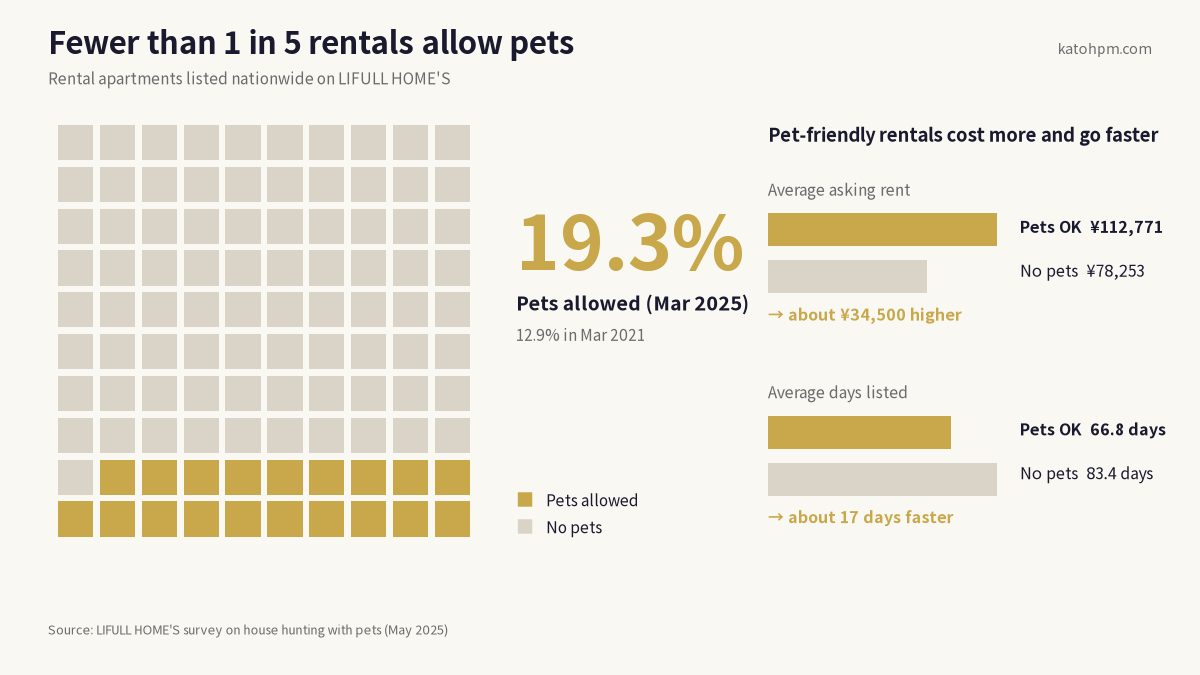
We helped a friend with a golden retriever look for a home in Setagaya, Tokyo, and could not find one. Only 19.3% of rental listings allow pets (LIFULL HOME'S listings, March 2025), and even pet-friendly homes often limit the size of the animal. This article looks at why finding a home with a large dog is hard, for rentals, condominiums and houses, and how to search.
Recently, we helped a friend who has a golden retriever look for a home in Setagaya, Tokyo. It was hard going. Whether for rent or for sale, most condominiums limited pets to “small dogs and cats.”
In the end, our friend bought a house with a garden in one of the cities outside Tokyo’s 23 wards, a little far from the station.
Whether you rent or buy, finding a home where you can live with a large dog is difficult. We used published survey figures to look at why.
How many rental properties allow pets?
Only 19.3% of rental properties nationwide allow pets. That is fewer than one in five.
This figure comes from LIFULL HOME’S, one of Japan’s largest property portals, based on apartments listed on its site. The share has risen from 12.9% in March 2021, but it is still below 20%. The same survey found that pet-friendly rentals cost about ¥34,500 more per month on average and are taken about 17 days sooner after listing.
With a large dog, the choice narrows further. Among people who searched for a pet-friendly home, 24.3% said that “limits on the type or size of pet” were a problem.
Why do so many homes allow only small dogs?
Landlords and management associations worry about damage and trouble with neighbors. Of real estate agents who had heard landlords’ reasons for banning pets, 74.2% cited “damage or dirt that leads to repair costs.”
In condominiums, pets are one of the main sources of trouble between residents. In the Ministry of Land, Infrastructure, Transport and Tourism’s 2023 condominium survey, pets accounted for 14.2% of the types of trouble between residents in the past year, third after noise (43.6%) and illegal parking (18.2%).
The fact that most pet dogs are small probably makes it easy to draw the line there. In the Pet Food Association’s 2024 survey, of 1,026 respondents with one dog, 131 (about 13%) had a medium or large dog.
If I buy a condominium, can I keep a large dog?
Not if the building’s rules say otherwise, even in a unit you own. Condominium buildings often set limits on the size and number of pets in their management rules and bylaws, and it is common for a building described as “pets allowed” not to accept large dogs.
Before buying, always check the management rules and bylaws for conditions on pets. Some buildings require pets to be carried or kept in a cart in common areas, which may not be realistic with a large dog.
How should I search for a home with a large dog?
As a broker, we recommend three things:
- Give the breed, weight and number of dogs up front. Do not rely on a “pets allowed” label; check the conditions for each property.
- Consider houses as well. Renting a house, or buying a house with a garden as our friend did, are both options.
- Widen the search area a little. Going a bit further from the station or across ward or city lines can add more candidates.
Homes that accept large dogs are taken quickly. In fact, when we made a rental house our company owns available to tenants with large dogs, it was let almost immediately. Decide your conditions in advance, be ready to move as soon as you find something, and keep searching. Feel free to contact us, including about your pet’s needs. We work in English or Japanese.
Sources
- LIFULL HOME’S, survey on house hunting with pets (May 2025, Japanese)
- Ministry of Land, Infrastructure, Transport and Tourism, 2023 Condominium Survey (Japanese)
- Pet Food Association of Japan, 2024 National Dog and Cat Ownership Survey (Japanese)
Note: This English article is a translation for reference; the Japanese version is the original.