Can you pay a real estate agent's fee in Japan with stablecoins (USDC, JPYC)? Conversion to yen and what to watch for
Katoh Property Management accepts USDC (Solana, Ethereum, Arbitrum) and JPYC (Ethereum) for the brokerage fee. Only the brokerage fee qualifies; the purchase price and rent do not. This Q&A explains which rate converts the yen fee, who pays network fees, how we verify the sender, and what happens above ¥1 million.
You can now pay our brokerage fee in USDC or JPYC as well as by bank transfer. We started this to offer people living outside Japan, and people who hold dollar assets, a simpler option than an international wire transfer.
Only the brokerage fee you pay us can be paid in stablecoins. This article explains which coins and chains you can use, how the yen fee is converted, and what to watch for.
Can you pay the brokerage fee in stablecoins?
Yes. You can choose USDC (on Solana, Ethereum or Arbitrum) or JPYC (on Ethereum). The fee itself is set in yen; stablecoins are simply one way to pay it.
| Coin | Chain | Suited to |
|---|---|---|
| USDC (US dollar) | Solana / Ethereum / Arbitrum | People living outside Japan, people with dollar assets |
| JPYC (Japanese yen) | Ethereum | People who hold a yen stablecoin |
A stablecoin is a digital currency issued to hold a one-to-one value with a currency such as the US dollar or the Japanese yen. It is not designed to swing in price like bitcoin, but it is sent over a blockchain in the same way as crypto assets.
For new inquiries through this site, LINE or a referral, our brokerage fee is half the legal maximum (for rentals, half a month’s rent plus tax; for sales, 1.5% of the sale price plus ¥30,000, excluding tax). Paying in stablecoins does not change the fee.
These rates apply to new inquiries received through this website, LINE or a personal referral. For properties we list ourselves on behalf of a seller or landlord (including on portal sites), the fee stated in that listing applies.
Can you pay the purchase price or rent in stablecoins too?
No. Only the brokerage fee you pay us is covered.
The purchase price goes from the buyer to the seller, and rent and deposits go from the tenant to the landlord or management company. That money is not paid to us. How it can be paid depends on the seller’s or landlord’s policy, and in most cases it is paid in yen, for example by bank transfer.
If you pay in USDC, how is the yen amount converted?
We use the US dollar telegraphic transfer middle rate (TTM) published by Mizuho Bank on the invoice date. 1 USDC is treated as 1 US dollar.
The calculation is:
USDC to pay = yen fee (including tax) ÷ TTM on the invoice date (rounded up to two decimal places)
For an apartment with a rent of ¥150,000, the brokerage fee is ¥82,500 including tax. If the TTM is ¥150 to the dollar, that is 82,500 ÷ 150 = 550.00 USDC.
The payment steps are:
- Agree on the payment method and timing: At the viewing or application stage, we agree on the coin and chain you will use and when you will pay
- We send the invoice: At the agreed time, after that day’s TTM is published (usually in the morning, Japan time), we send an invoice showing the USDC amount
- Send the payment: Please send it within 3 business days of the invoice. If the deadline passes, we issue a new invoice and recalculate at that day’s rate
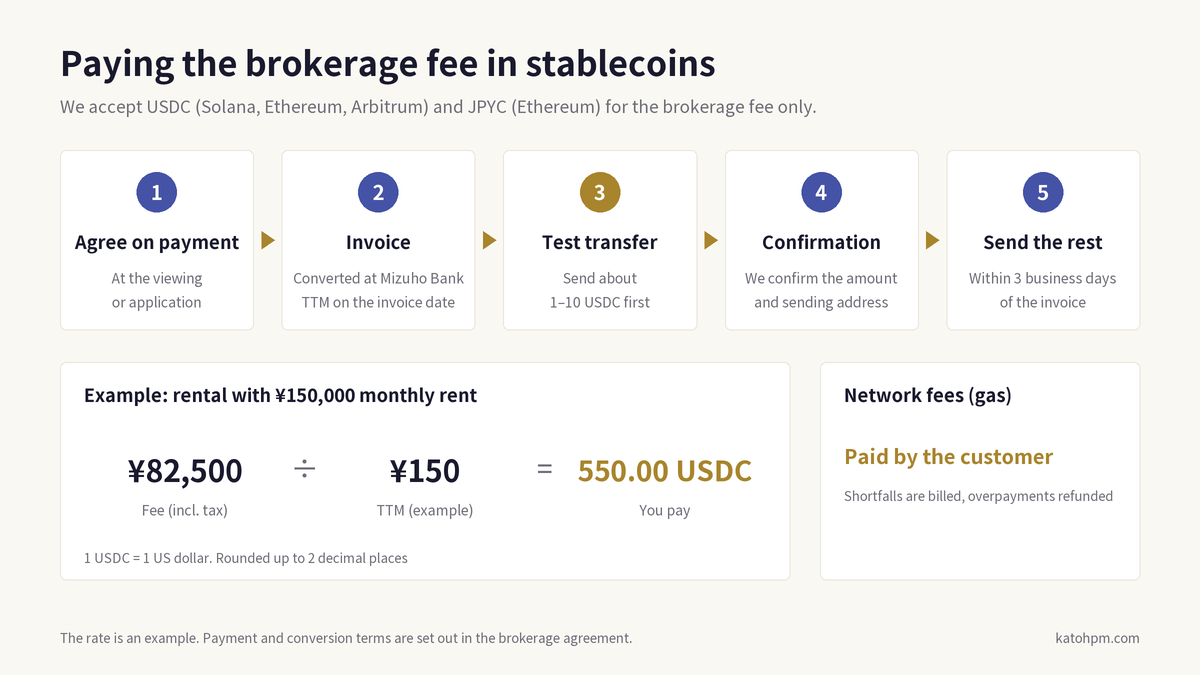
We keep the rate date close to the payment date so that a large move in the dollar-yen rate does not push the yen value of your payment away from the fee.
The TTM is the midpoint between the rate at which a bank sells foreign currency (TTS) and the rate at which it buys it (TTB). We use it so that neither side is favored.
What if the fee for a sale is paid in two installments?
Each installment is converted at the rate on its own invoice date. The total fee in yen stays as stated in the brokerage agreement.
For sales, it is common to pay half the brokerage fee when the sales contract is signed and the other half at settlement (handover). For a ¥70 million home, the fee is ¥1,188,000 including tax, or ¥594,000 per installment.
| Yen amount (incl. tax) | TTM (example) | USDC to pay | |
|---|---|---|---|
| At the sales contract | ¥594,000 | ¥150 | 3,960.00 USDC |
| At settlement | ¥594,000 | ¥145 | 4,096.56 USDC |
The rates in the table are examples. If the rate moves, the USDC amount for the second installment changes as well.
If the contract is cancelled, how is the fee refunded?
We return the same quantity of USDC (or of JPYC, if you paid in JPYC) to the address you sent it from.
In some cases, such as when a sales contract is cancelled because the mortgage is not approved, the brokerage agreement requires us to refund the fee. We then return the same quantity you paid, without recalculating it in yen.
| When you paid | When refunded | |
|---|---|---|
| USDC quantity | 3,960.00 USDC | 3,960.00 USDC |
| TTM (example) | ¥150 | ¥140 |
| Value in yen | ¥594,000 | ¥554,400 |
If the dollar-yen rate has moved since you paid, the yen value of the refunded USDC will differ. Think of it as getting back the USDC you paid.
Who pays the network fee (gas)?
The customer. It works the same way as an international bank transfer, where the sender pays the transfer fee.
- If we receive less than the invoice: we will ask you to pay the shortfall
- If we receive more: we refund the excess
Solana and Arbitrum have low network fees and settle quickly. Ethereum is supported by more exchanges and wallets, but fees can be higher when the network is busy.
What should you watch for when sending?
Send the coin stated on the invoice to the chain and address stated on the invoice. If you use the wrong chain, the funds may not be recoverable.
- For Ethereum-style chains, only Ethereum mainnet and Arbitrum (Arbitrum One): We do not accept transfers from other chains that use Ethereum-style addresses, such as Base, Optimism or Polygon. JPYC is accepted on Ethereum mainnet only
- Copy the address from the invoice every time: Avoid copying it from your transaction history. Some scams send small amounts from look-alike addresses so that you copy the wrong one from your history
- We give our receiving address only on the invoice: If an email or social media message gives you a different address, do not send to it
Do you need to make a test transfer?
As a rule, we ask you to send a small test transfer first. This catches a wrong chain or address while the amount is still small.
- Test transfer: Send about 1–10 USDC (for JPYC, a few hundred yen) to the address on the invoice
- Confirmation: We confirm receipt and tell you the amount received and the sending address
- Send the rest: After hearing from us, send the remaining amount from the same address
The test amount counts toward your payment. You also pay the network fee for the test transfer. Please send the rest within the invoice deadline as well.
How do we verify your identity?
Tell us your sending address in advance, and we confirm that it belongs to you. We cannot accept payments from anyone other than you.
- Tell us the sending address: Give us, in writing, the address you will pay from
- Address check: If you send from an exchange account in your own name, we check that account’s details. If you send from a wallet you manage yourself, we confirm the address is yours, for example by asking you to sign a message we specify with that wallet
- Payment: Send from the address you gave us. We confirm during the test transfer that the funds came from that address
For sales, we verify every client’s identity as required by law (name, address, date of birth, purpose of the transaction, occupation and so on), whatever the payment method. Identity documents can also be submitted online.
What if the amount exceeds ¥1 million?
With USDC, you can pay in one transfer. With JPYC, please talk to us first.
JPYC issuance (exchanging yen for JPYC) and redemption (exchanging JPYC for yen) are limited to ¥1 million per transaction. If the brokerage fee exceeds ¥1 million, preparing enough JPYC may take extra effort on your side. When a sale fee is paid in two installments, each one is often under ¥1 million, so let us know when you get in touch.
Can you pay in USDT or bitcoin?
No. We accept only USDC and JPYC.
USDT is a widely used stablecoin, but registered providers in Japan hardly handle it. That limits our ability to convert it to yen after receiving it, so we do not accept it. Crypto assets such as bitcoin and ether are not accepted because their prices move too much.
What should you tell us when you get in touch?
Send your first inquiry through the form or LINE as usual. Just add that you would like to pay the brokerage fee in stablecoins.
Details such as the coin, chain and timing of payment are agreed at the viewing or application stage. What we agree (payment method, conversion rate and treatment of network fees) is written into the brokerage agreement as special terms. For how each service works and what it costs, see Renting, Buying and Selling. How the process works without visiting an office is explained in How do you rent or buy in Japan without visiting an agency office?
Note: The rules for stablecoins (electronic payment instruments) in Japan are still being revised under the Payment Services Act and other laws. This article describes how we handle stablecoin payments as of October 2026, and the details may change. For how paying in stablecoins affects your own taxes, please consult your own tax advisor. The amounts and rates in this article are illustrative. Contracts and the explanation of important matters are in Japanese, which is the binding version; English translations are provided for reference (points to be confirmed for each transaction). This English article is a translation for reference; the Japanese version is the original.